
Financial Architecture
A three-layer framework that provides structural clarity as financial complexity increases.
Why Architecture Matters
Most growing businesses treat finance as a compliance function: closing books, filing taxes, generating reports. Accuracy is necessary. It is not sufficient.
As operations expand, capital commitments increase and decision consequences compound. Financial systems must do more than record history. They must provide a coherent structure that supports consistent judgment.
Financial architecture is the deliberate design of systems, controls, and decision frameworks that convert financial data into operating signal and operating signal into disciplined capital allocation.
The Three-Layer Model
Each layer supports the one above it. When structural integrity weakens at the foundation, every higher-level decision becomes heavier than it should be.
Without coherence at the base, management debates numbers. Without management clarity, strategy becomes assumption.
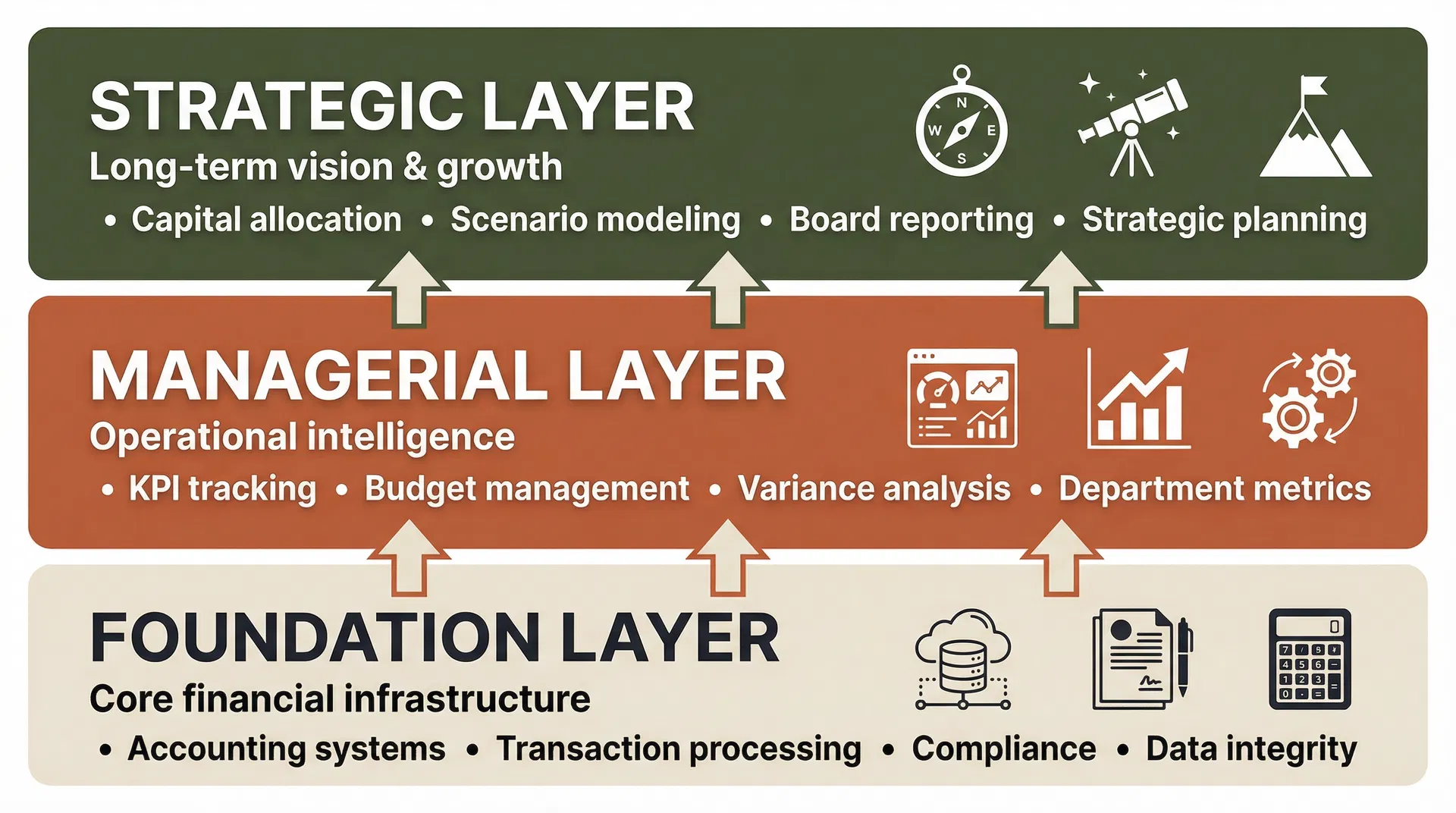

Layer 1: Foundation
Core Systems & Data Integrity
The foundation layer establishes reliable data capture, reconciliation discipline, and structural consistency. As complexity increases, integrity must remain stable.
Without this layer, performance discussions revert to validation instead of execution.
Chart of Accounts Design
Structured to reflect operational drivers, not only tax categories.
Process Documentation
Defined workflows for AP, AR, payroll, and month-end close that reduce ambiguity.
Controls & Compliance
Clear approval thresholds, segregation of duties, and visible audit trails.
System Integration
Alignment between accounting, banking, payroll, and operational tools to prevent fragmentation.
Layer 2: Managerial
Operational Oversight & Decision Support
The managerial layer converts accounting output into operating clarity. It answers whether performance aligns with expectations and whether capital is deployed with intention.
KPI Dashboards
Visibility into revenue quality, cost behavior, and unit economics.
Budget vs. Actuals
Structured variance analysis that highlights deviation early.
Cash Flow Forecasting
Rolling forecasts that support liquidity discipline rather than reactive adjustment.
Department-Level Analytics
Cost allocation and profitability visibility that prevents optimization of the wrong metrics.


Layer 3: Strategic
Long-Term Vision & Capital Allocation
The strategic layer connects structural performance to irreversible decisions. It governs how growth is funded, how risk is measured, and how commitments are evaluated.
Fundraising Strategy
Capital structure clarity, scenario awareness, and disciplined funding pathways.
Growth Modeling
Projection frameworks that align expansion with operational capacity.
Exit Planning
Preparation that strengthens valuation through structural readiness.
Board-Level Reporting
Clear communication of risk, capital allocation, and long-term priorities.
How We Build Your Financial Architecture
We do not implement all three layers simultaneously. Architecture is built in sequence.
We assess structural gaps, prioritize constraints that affect decision reliability, and reinforce each layer before advancing to the next.
Diagnostic
Evaluate system coherence, identify structural weaknesses, and clarify where decision risk accumulates.
Design
Define the architecture: processes, reporting logic, and control thresholds aligned with your growth stage.
Implementation
Embed the structure within your organization so the system remains stable beyond the engagement.
Ready to Build Your Financial Architecture?
Begin with a diagnostic to understand where structural clarity is strong and where reinforcement is required.